

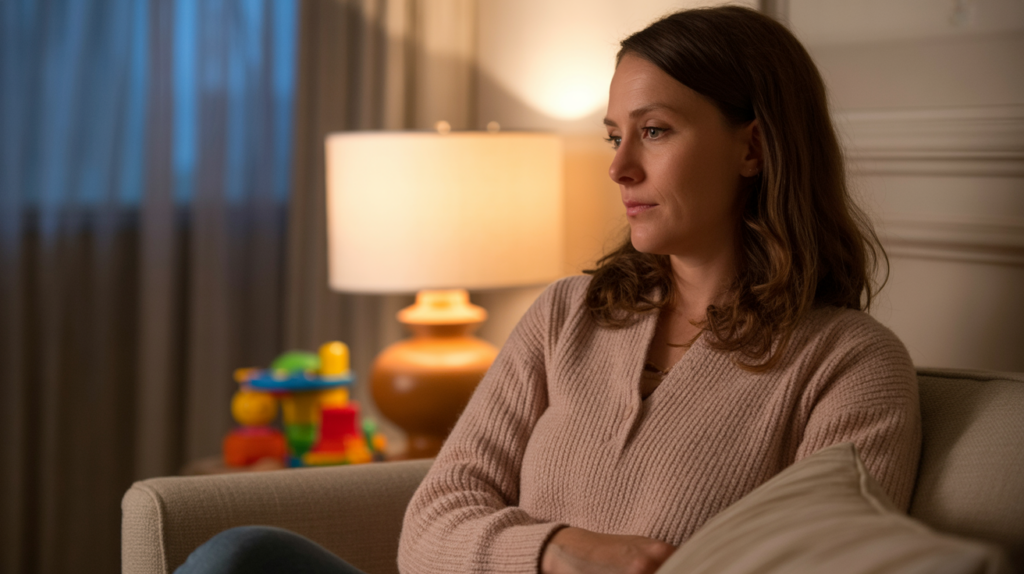
You snapped at them today. Or you checked your phone instead of getting down on the floor to play. Or you counted down the minutes until bedtime, then felt guilty the moment the house went quiet. Maybe it was something smaller — a sharp tone, an impatient sigh, cereal for dinner again — and now you’re lying there in the dark wondering: am I a bad mom?
Here’s what I want you to sit with before we go any further: the fact that you’re asking that question is itself the answer. Bad mothers don’t lie awake wondering if they’re bad mothers. They don’t Google it at midnight. They don’t feel sick at the thought of having hurt their child. You do. That matters.
The feeling is real. The guilt is real. But the story your brain is telling you — that this feeling means you’re failing — is almost certainly not.
Why Do I Feel Like a Bad Mom All the Time?
If it sometimes feels like you can’t get through a day without doubting yourself as a mother, you are far from alone. 94% of moms surveyed by BabyCenter report experiencing parenting-related guilt — a number so high it tells us something important: this is not a personal failure. This is a near-universal experience of modern motherhood.
Part of why this feeling is so relentless is structural, not personal. Mothers in most Western countries carry a disproportionate share of both physical and invisible labor — the “second shift” of caregiving, mental load, and emotional regulation that doesn’t clock out. Despite this, 78% of mothers report guilt about not spending enough time with their children — an impossible math in which doing more never feels like enough.
Then there is social media. A survey of over 1,000 mothers found that 72.5% compare themselves to other moms on social media, with nearly 35% feeling pressure to portray a “perfect” parenting lifestyle. When your morning looks like chaos and your phone shows someone else’s curated calm, the comparison corrodes something quiet in you. You’re measuring the full reality of your own life against someone else’s highlight reel. That comparison was never going to be fair.
And underneath all of this runs something even older: the cultural myth that a good mother is infinitely patient, always present, never depleted, and fundamentally selfless. As author Adrienne Rich captured so plainly in Adrienne Rich, Of Woman Born (1976) — motherhood and guilt have been bound together for a very long time. The standards were designed to be impossible to meet. The guilt you carry is not a sign that you’re failing them. It’s a sign that you’re human, trying, inside a system that was never built to support you.
Is It Normal to Feel Like a Terrible Mother?
Yes — and not just normal, but almost universal. Research published by the British Psychological Society found that implicit cultural expectations tie mothers to family roles in ways that fathers simply are not, creating a guilt gap that isn’t rooted in how good you are as a parent but in how much more you’re expected to be. Mothers who work outside the home feel guilty for being away. Mothers who stay home feel guilty for not contributing financially. The inner critic finds material everywhere.
Clinical psychologist Dr. Becky Kennedy, named TIME magazine’s “Millennial Parenting Whisperer” and author of Dr. Becky Kennedy, Good Inside (2022), offers a framework that many parents find transformative: guilt is the emotion we feel when we’ve acted outside our own values. It’s not evidence that we’re a bad person — it’s a signal that we care. The problem comes when guilt turns into shame, when “I did something hard” becomes “I am something wrong.” That’s the spiral most of us know too well.
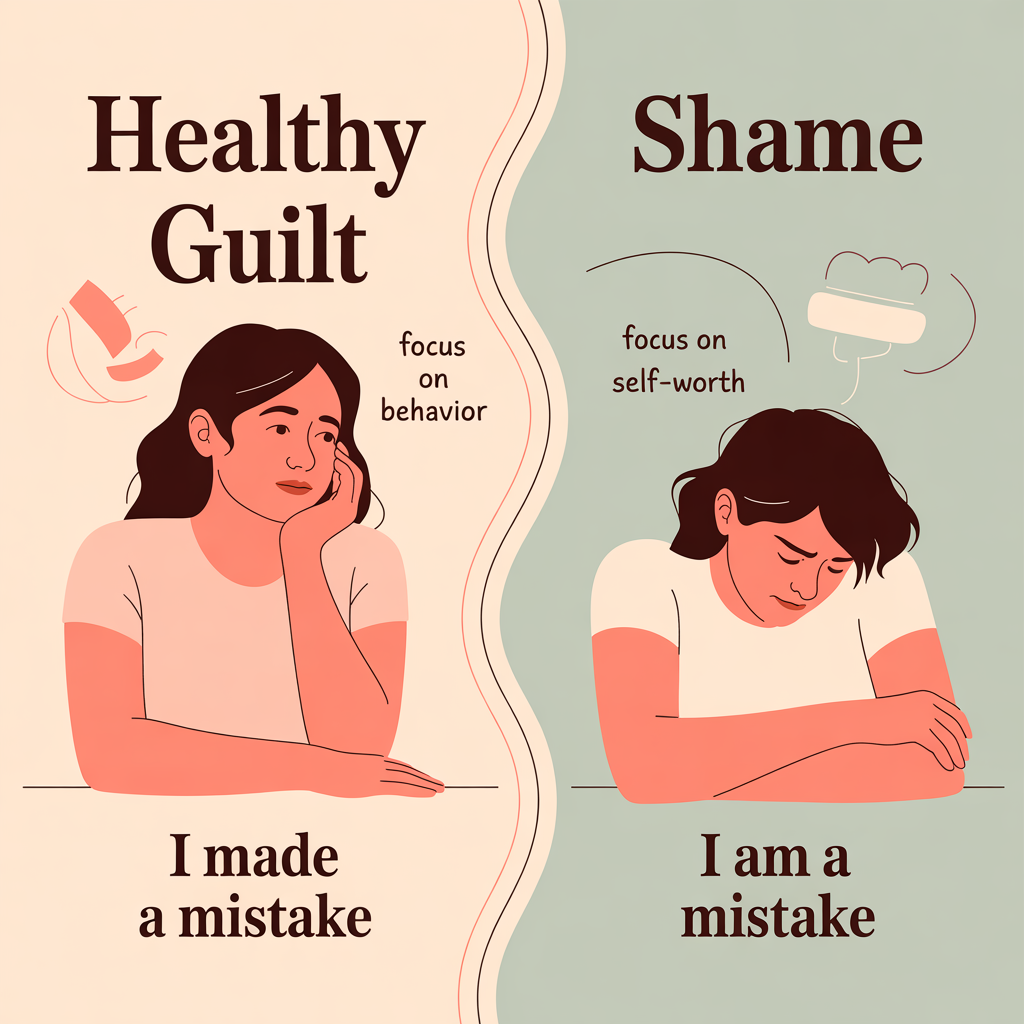
Dr. Kennedy’s core message — that both parents and children are fundamentally good inside, doing the best they can with the resources available to them in any given moment — isn’t feel-good platitude. It’s a reframe that actually changes how you can respond. When you believe you’re a bad mom, you can’t take effective responsibility for a hard moment. When you believe you’re a good mom who had a hard moment, you can repair it, learn from it, and move forward.
What Does a Bad Mom Actually Look Like?
A bad parent is one who consistently and deliberately neglects a child’s core needs — who withholds food, safety, or care, who routinely puts their own comfort above a child’s welfare without repair, who is cruel or abusive on a pattern. If you’re reading this, lying awake because you lost your patience today, you are not that person. The very fact that it kept you up is evidence of the opposite.
Bad days, big feelings, exhaustion, frustration, yelling once in a parked car, feeding them crackers for dinner — none of these things make you a bad mother. They make you a parent. There’s a meaningful difference.
The “Good Enough Mom” — What Research Actually Says About Imperfect Parenting
One of the most powerful ideas in developmental psychology is also one of the least known outside academic circles. In 1953, British pediatrician and psychoanalyst Donald Winnicott introduced the concept of the “good enough mother.” After observing thousands of mothers and babies, Winnicott came to a radical conclusion: children do not need a perfect parent. They need a present, responsive-enough parent who allows them to experience small, manageable imperfections.
As Winnicott described it, the good-enough mother begins with near-total attunement to her infant’s needs, then — gradually, naturally — allows small moments of frustration and disappointment. These “micro-failures” are not damage. They are the mechanism through which children build resilience, independence, and the understanding that relationships can survive imperfection. Winnicott’s work suggests that striving for perfection isn’t just unnecessary — it can actually be counterproductive.
This lands differently when you’re in the middle of a hard day. But it matters deeply: the moments when you don’t get it exactly right, the times you repair after snapping at your child, the evening you apologize and reconnect — these aren’t signs of failure. According to both Winnicott’s framework and Dr. Becky Kennedy’s modern application of it, repair is one of the most powerful things a parent can offer. It teaches a child that relationships can rupture and heal. That love doesn’t require perfection. That the people who care for us also get it wrong sometimes, and that’s survivable.

Does Feeling Like a Bad Mom Mean You Care?
Yes — and the research supports this. Multiple studies on maternal guilt have found that the parents who experience the most guilt about their parenting are often the most conscientious, attuned caregivers. Guilt, at its healthiest, is a pro-social emotion: it emerges when you care about the impact of your behavior on someone you love. The parent who feels nothing when they yell at their child is not less guilty — they’re less connected.
The language of parenting forums captures this truth in a way that clinical language sometimes can’t. Across thousands of threads, the pattern repeats: a mom confesses something she’s ashamed of — losing her temper, not enjoying a phase, not being the mother she imagined she would be — and the response that floods in is “oh my god, me too.” That collective exhale of recognition is not evidence of widespread failure. It’s evidence of a standard so impossibly high that almost everyone struggles beneath it.
You are not uniquely broken. You are in very large, very tired, very loving company.
How Do I Stop Feeling Like a Bad Mom?
The honest answer is that you probably won’t stop feeling it entirely — guilt is part of caring. But you can change your relationship to it. You can learn to let it inform you rather than define you. A few approaches that are grounded in both research and real parent experience:
Name what the feeling is actually about. “I feel like a bad mom” is a label that collapses a lot of distinct emotions into one crushing verdict. Get underneath it. Are you feeling overwhelmed? Ashamed of a specific moment? Scared about a pattern? Lonely and depleted? The more specific you can get, the less power the label has — and the more clearly you can see what you actually need.
Repair when you get it wrong. This is perhaps the single most actionable thing developmental psychology offers parents. You don’t need to have been perfect. You need to come back, reconnect, and acknowledge what happened. A simple “I shouldn’t have yelled — I was really overwhelmed, and that’s not your fault” gives your child something more valuable than a parent who never slips: it gives them a model for what it looks like to take responsibility and make things right.
Offer yourself the compassion you’d offer a friend. Dr. Kristin Neff’s research on self-compassion makes this concrete: most of us would never speak to another struggling mother the way we speak to ourselves. If your closest friend called you and described exactly what happened in your hardest parenting moment today, what would you say to her? Say that to yourself. It is not the same as making excuses. It is the beginning of being able to do better.
Audit your comparison inputs. Guilt and comparison are deeply connected. Nearly 1 in 5 mothers surveyed said social media has negatively influenced their parenting, and nearly three-quarters compare themselves to other moms online. You don’t have to leave social media entirely, but you can be intentional about whose version of motherhood you let into your head, especially on the hard days.
Find your people. The “me too” effect that shows up so consistently in parenting communities is real and meaningful. Shame shrinks in the presence of honest company. Whether it’s a friend, a forum, a therapist, or a community — the experience of being known and not judged for the messy parts of parenting is genuinely healing.
If you’re in one of those hard moments right now — the kind where the guilt is loud and sleep feels far away — Daily Parent is a free iOS app built for exactly this. It delivers science-backed affirmations designed specifically for parents who are hard on themselves — the kind of gentle, grounding reminders that can interrupt the spiral at 11pm when you need them most. It’s not a fix, but it’s a small, warm thing in your corner on the days when you need your own version of “me too.”
How Do I Forgive Myself for Being a Bad Mom?
Start by questioning the premise. You are likely not forgiving yourself for being a bad mom. You are forgiving yourself for being a tired, imperfect, deeply human person who loves their child and sometimes gets it wrong. Those are different things, and the distinction matters.
Forgiveness in parenting doesn’t mean minimizing what happened or deciding it doesn’t matter. It means choosing not to let one moment — or one season — become the whole story of who you are as a mother. Your child’s experience of you is not a single moment. It is thousands of moments: the mornings you showed up, the times you came back to apologize, the meals you made, the quiet bedtimes, the times you laughed together, the times you stayed even when it was hard.
Dr. Becky Kennedy offers a frame worth sitting with: the most important parenting strategy is not getting it right the first time. It’s repair. The willingness to return, to acknowledge, to reconnect — that is what your child learns from. That is what builds the relationship. And that willingness? You already have it. You’re here.
The fact that you’re still reading this, still searching, still caring enough to ask — that’s not the behavior of a bad mother. That’s the behavior of a good one, in a hard season, trying her best. And that is, genuinely, good enough.