

You worked late again. Or maybe you were home but distracted, answering emails at the dinner table while your kid tried to show you something. Or you lost your patience when you swore you would not. And now it is quiet, and that familiar weight is back: the low-level hum of feeling like you are not quite enough.
That is dad guilt. And if you have never heard it talked about the way mom guilt is, that is part of the problem.
Dad guilt is real, it is common, and it runs deeper than most fathers let on. This article is here to name it, explain why it hits so hard, and give you something actually useful to do with it.
What Is Dad Guilt?
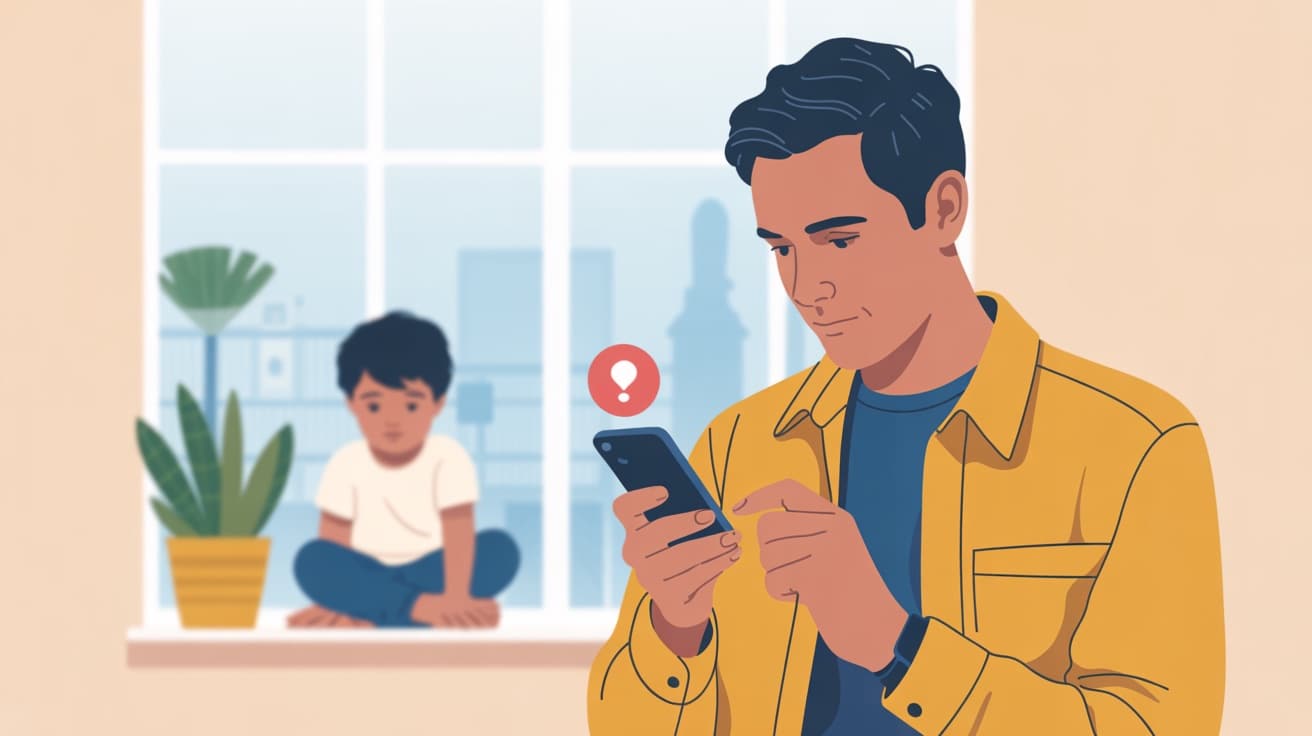
Dad guilt is the persistent feeling that you are falling short as a father: that you are not present enough, not patient enough, not providing enough, or not emotionally available enough. It is the internal verdict of “not good enough” that shows up after a long day at work, after you miss a school play, after you snap at your kid over something small, or after you scroll your phone when you meant to be present.
Unlike guilt that follows a clear mistake, dad guilt often operates as a chronic background noise: a quiet, ongoing verdict that you are failing in some direction no matter what you do.
Is Dad Guilt Normal?
Dad guilt is extremely common, though it is discussed far less openly than its counterpart. According to a survey of 1,200 fathers conducted by Fatherly and Today.com, nearly 1 in 5 dads (19%) feel guilty about not being present enough with their children, and 17% say they feel guilty about working too much. A separate Pew Research study found that 46% of fathers, nearly half, say they spend too little time with their kids.
A 2025 study published in the Journal of Family Studies found that fathers, when interviewed about their parenting journey, described their experiences through the lens of guilt and mental health “without prompting”, suggesting that this feeling is not an edge case, but a defining feature of modern fatherhood that simply does not get named enough.
Why Is Dad Guilt So Hard to Talk About?
Dad guilt often goes unspoken for reasons that compound the problem. Many fathers grew up absorbing the message that their job is to provide, not to process emotions. So when the guilt arrives, there is frequently no space to put it, no community to name it in, and a background belief that feeling this way is somehow less legitimate than the well-documented experience of mom guilt.
The result? Dads sit with it alone. They work harder to compensate, or they disconnect slightly, or they snap at the people they love most, and then feel guilty about that too.
Research on paternal mental health makes the stakes clear. Studies show that 1 in 10 fathers experience depression or anxiety during the first year of parenthood. And according to Rutgers University research published in the American Journal of Preventive Medicine, unaddressed paternal depression can affect children’s behavior and social development for years. Getting a handle on dad guilt is not just about your peace of mind; it matters for your kids too.
The Double Bind: Why Modern Dads Can Never Win
Modern fatherhood has created a genuinely new and difficult tension. Previous generations of fathers were largely defined by one role: provider. Today’s dads are expected to be both deeply present, emotionally engaged, actively involved in childcare, and financially providing and career-advancing.
The problem is that these two demands are often in direct conflict. Work more and you feel guilty for being absent. Pull back from work and you feel guilty for not providing enough. According to Pew Research, 63% of dads say they spend too little time with their kids, and fathers are far more likely than mothers to report that work demands get in the way of family time.
There is no “correct” balance. And the impossibility of that equation is precisely where so much dad guilt lives.
How to Deal With Dad Guilt: 6 Practical Steps
Dad guilt may never disappear entirely. Some of it is just the cost of caring this much. But it can be managed, redirected, and stopped from running your emotional life. Here is what actually helps.
Name it out loud, even just to yourself
The first step is deceptively simple: call it what it is. Dad guilt. Guilt about not being there. Guilt about your temper. Guilt about the financial pressure. When you name the emotion specifically rather than just feeling a vague heaviness, you put yourself in the driver’s seat. Simply saying, “I feel guilty that I missed dinner again tonight,” is more useful than carrying an unnamed weight around.
Distinguish between useful guilt and toxic guilt
Useful guilt is a signal. It tells you that something you care about needs attention. If you have been genuinely absent for weeks and your kid is asking for you, that guilt is pointing at something actionable. Toxic guilt is the chronic, disproportionate kind that shows up even when you are doing your best: the guilt of working a full day, taking 20 minutes for yourself, or not attending every single event.
Let presence beat quantity every time
One of the most unhelpful beliefs in dad guilt is the idea that more hours automatically means better dad. But a review by the OECD found that what matters for children’s development is the quality of father-child interaction, not only the quantity. Fifteen minutes of genuinely undivided attention can mean more to your child than two hours of distracted proximity.
Stop comparing your behind-the-scenes to everyone else's highlight reel
Social media has made comparison-based guilt worse. You see other dads at every school event, coaching every team, radiating patience, and you are at work again, exhausted again, or needing 10 minutes of silence. What you cannot see is that those same dads have their own late-night guilt spirals. Your kids do not need a perfect dad. They need a real one who shows up and tries.

Talk to another dad about it
The isolation of unspoken dad guilt is part of what makes it so heavy. One of the most effective things you can do is break that silence with another father you trust. When you admit “I feel like I am failing at this” and someone else says “me too,” the guilt loses power. It becomes a shared human experience rather than evidence of your specific inadequacy.
Actively reframe what "good enough" looks like
Dad guilt is often fueled by an internal standard no human being can meet: a composite of every great dad you have ever seen, social media, and your own childhood ideal. Good enough fathering is not perfect fathering. It is showing up most of the time, repairing after you lose your temper, and building years of small, ordinary moments of love.

You are doing better than you think.
Daily Parent is a free iOS app built for parents navigating guilt, self-doubt, and the emotional weight of trying to show up every day. It is a daily reminder that you do not have to carry this alone.
Download on theApp StoreFrequently Asked Questions
What is dad guilt?
Dad guilt is the persistent feeling that you are not doing enough as a father: not present enough, patient enough, providing enough, or emotionally available enough. It is a form of parental guilt specific to fathers, often intensified by the modern expectation that dads should be both fully engaged parents and high-performing providers at the same time.
Is dad guilt normal?
Yes, dad guilt is very common. Studies show that nearly half of fathers feel they spend too little time with their children, and surveys of over 1,000 fathers found that roughly 1 in 5 feel guilty about not being present enough. Dad guilt is a natural result of caring deeply, but it does not have to run your life.
Why do dads feel guilty about working?
Modern dads are caught between two competing expectations: be the provider and be fully present. When work demands time away from family, it creates a real conflict between two things you care about. The resulting guilt is not a sign of failure. It is a sign you are trying to honor both roles in a world that does not make that easy.
What is guilty father syndrome?
Guilty father syndrome is a term sometimes used to describe a pattern where fathers, particularly after divorce or separation, overcompensate for perceived failure by giving children everything they ask for, avoiding discipline, and struggling to set boundaries. It is an extreme form of dad guilt that can undermine children by depriving them of structure.
Can dad guilt cause depression?
Chronic, unaddressed guilt can contribute to paternal depression and anxiety. Research shows that 1 in 10 fathers experience depression or anxiety in the first year of parenthood, and studies link unresolved paternal mental health struggles to long-term impacts for children. If guilt is persistent, overwhelming, or affecting your daily functioning, it is worth speaking to a doctor or therapist.
Does dad guilt ever go away?
Dad guilt tends to evolve rather than disappear entirely. As children grow and circumstances change, the triggers shift, but the drive to do right by your kids does not disappear. What can change is your relationship to guilt: learning to separate useful guilt from toxic guilt, and building enough self-compassion to carry it more lightly.
How do I stop feeling like a bad dad?
Start by questioning whether "bad dad" is actually accurate. Most fathers who worry about being bad dads are, by definition, invested enough to worry, which is itself a sign of care. Focus on what you are doing, not only what you are missing. Prioritize quality of connection over quantity of time, and give yourself credit for showing up in ways that often go unseen.