

You snapped at your kid for something tiny. You cried in the car. You got through the day, but just barely, and tonight you’re lying in bed replaying everything you did wrong. If this is you right now, here’s what matters most: you are not broken, and you are not alone.
Feeling completely overwhelmed as a parent isn’t a sign that you’re failing. It’s often a sign that you care deeply, and that you’re carrying more than any one person was designed to carry alone.
Is It Normal to Feel Overwhelmed as a Parent?
Completely. A 2024 advisory from the U.S. Surgeon General found that 48% of parents say their stress feels completely overwhelming on most days, nearly double the rate of non-parents. The advisory, titled Parents Under Pressure, was significant enough that it called parental stress a public health crisis.
So whatever you’re feeling right now? Millions of parents are feeling it too.
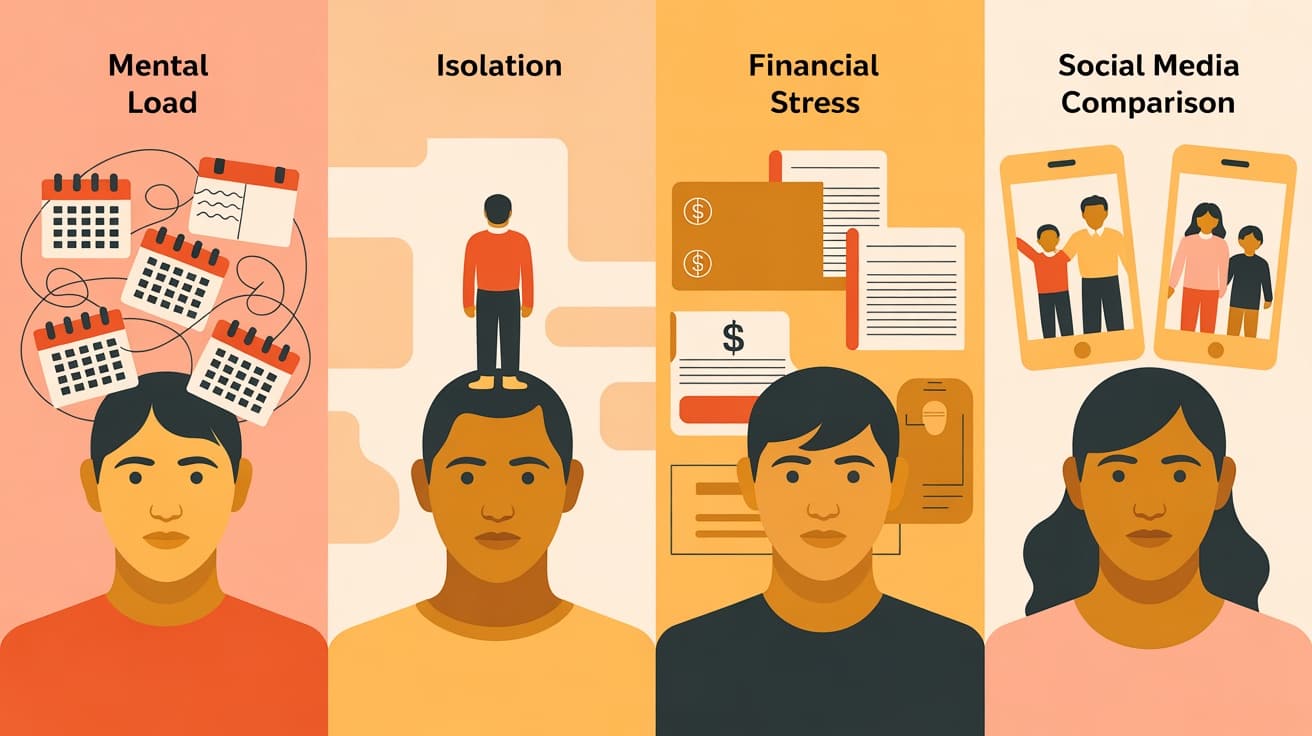
Why Do Parents Feel So Overwhelmed?
It’s not one thing. It’s the pile-up. Modern parenting happens at a pace and pressure level that previous generations simply didn’t face. Here’s what’s actually driving the overwhelm for most parents:
- The mental load. You’re not just doing the things. You’re thinking about them, planning them, remembering them. Who needs new shoes? When is the dentist? Did we RSVP to that birthday party? This invisible cognitive labor runs constantly, often with no acknowledgment.
- Social comparison. Social media presents curated snapshots of other families looking effortlessly happy and organized, which makes your own messy reality feel like evidence you’re failing.
- Isolation. Modern parenting is often done without the surrounding community or extended family support that used to make it sustainable. Many parents are raising children far from family, without close friends nearby.
- Financial stress. The cost of childcare has climbed sharply, and one in four parents reports struggling to cover basic needs like food and rent.
- The “perfect parent” myth. A culture that celebrates achievement in every domain, including parenting, sets an impossible standard that guarantees most parents will feel like they’re falling short.
Professor Isabelle Roskam of UCLouvain, who has studied parental burnout extensively, notes that one of the most powerful things a parent can do is abandon the idea of the perfect parent altogether and choose instead what actually works for their family.
What Are the Signs of Parental Burnout?
Parental burnout is more than a bad week. It’s a state of deep exhaustion specific to the parenting role, and it looks different from general stress. Some signs to watch for:
- Feeling emotionally distant from your kids, like you’re going through the motions
- Snapping at small things, or losing your temper more easily than usual
- A bone-deep tiredness that sleep doesn’t fix
- Feeling like you can’t stand one more demand, question, or meltdown
- Shame and guilt that follows you even on okay days
- A sense of being an ineffective parent, even when you’re doing your best
If several of these feel familiar, you’re not weak. You’re depleted. And depletion is something you can actually address.
What to Do When You’re Completely Overwhelmed as a Parent
When you’re in the thick of it, you don’t need a 30-step wellness plan. You need a few things that actually work, starting right now.
Start with self-compassion, not self-criticism
This is the hardest one for most parents, and also the most important. Dr. Becky Kennedy offers a simple mantra for moments of overwhelm: “Parenting feels hard because it is hard.” Place a hand on your heart and repeat it until something in your body softens.
Name what you're actually feeling
Take 30 seconds and check in: What does your body feel like right now? What thought keeps coming up? Are you exhausted, resentful, scared, lonely, or all four at once? A parent who knows they’re running on empty makes different choices than one who just keeps pushing.
Use the HALT framework
Before you spiral further, ask: Am I Hungry, Angry, Lonely, or Tired? These four basic states narrow your window of tolerance and make everything feel harder than it is. Addressing even one of them can genuinely shift your capacity to cope.
Ask for specific help
Parents in distress rarely ask for help, and when they do, they often make it too vague. “Can you take the kids Saturday morning so I can sleep?” is something a friend or partner can actually say yes to. Start with one specific thing, one specific person, one ask.
Drop the lowest-priority item on your list
When everything feels urgent, the answer isn’t to do more efficiently. It’s to do less. Ask yourself: What is the one thing I can skip, delay, or hand off today? The laundry can stay unfolded. Dinner can be a frozen pizza. This is triage.
Repair after the hard moments
If you lost your temper or said something you regret, you don’t have to carry that forever. A simple repair sounds like: “I got really frustrated earlier and raised my voice. That wasn’t your fault. I’m working on it, and I love you.”

A small daily anchor can change the texture of the day.
Daily Parent is a free iOS app built for moments like this one. It delivers daily affirmations designed to counter the guilt, comparison, and self-doubt that overwhelmed parents carry: gentle reminders, right when you need them, that you are a good parent doing a hard job.
Download on theApp StoreHow Do I Stop Feeling So Overwhelmed as a Parent?
The honest answer: not all at once, and not by fixing everything. Parental overwhelm rarely has a single solution. It usually requires a combination of reducing stressors, building support, and changing the story you tell yourself about what’s happening.
Start with the smallest, most accessible lever. For some parents, that’s asking one person for one specific thing. For others, it’s giving themselves permission to have a bad day without treating it as evidence of failure. For others still, it’s talking to a therapist who can help them untangle the stress they’ve been managing alone.
Progress doesn’t look like never feeling overwhelmed again. It looks like getting out of the spiral faster, with less damage to yourself and the people you love.
When Should I Seek Professional Help?
If overwhelm has become your baseline, if you feel emotionally absent from your children, if you’re experiencing persistent anxiety, depression, or hopelessness, or if you’re struggling to get through basic daily tasks, it’s time to reach out to a mental health professional or your primary care provider. This isn’t failure. It’s the same thing you’d tell your child to do.

Frequently Asked Questions
Is it normal to feel overwhelmed as a parent?
Yes, and it's more common than most parents realize. According to the 2024 U.S. Surgeon General's advisory, nearly half of all parents in the United States say their stress feels completely overwhelming on most days. Feeling this way doesn't mean you're a bad parent; it means you're carrying a lot without enough support.
What are the signs of parental burnout?
Parental burnout typically involves deep emotional exhaustion, feeling detached or distant from your children, losing patience much more easily than usual, and a sense of being ineffective as a parent no matter how much effort you put in. It's more than a bad week; it tends to persist and affect day-to-day functioning.
What should I do when parenting becomes too much?
Start by naming what you're feeling rather than pushing through it. Then identify the most accessible thing you can do right now: ask one person for one specific form of help, drop the lowest-priority task on your list, or take 10 minutes alone. Small, concrete actions are more effective in the moment than trying to overhaul everything at once.
Why is parenting so exhausting?
Because it involves constant emotional attunement, relentless decision-making, a significant invisible mental load, and very little external validation, all while managing your own emotions, work, relationships, and life. Many parents also lack the community support that makes parenting sustainable.
How do I cope with parenting stress?
Key strategies include practicing self-compassion instead of self-criticism, asking for specific help from people in your life, identifying your basic unmet needs using a framework like HALT, reducing commitments where possible, and building a small daily anchor that gives you a moment that belongs to you. If stress is persistent, talking to a therapist can make a significant difference.
What does it mean when a parent is overwhelmed?
It means the demands of parenting have exceeded their current resources: emotional, physical, and logistical. This isn't a character flaw; it's a mismatch between what's being asked and what's available. Addressing overwhelm usually means both reducing demands and building resources, not just pushing harder.
How do I stop feeling guilty as a parent?
One place to start is separating identity from behavior: losing your temper or having a bad day doesn't make you a bad parent. It makes you a good parent having a hard time. Repair what you can, and extend to yourself the same compassion you'd offer a friend going through the same thing.
When should I seek professional help for parental overwhelm?
If you're persistently feeling detached from your children, experiencing symptoms of anxiety or depression, struggling to function day to day, or feeling like things aren't getting better on their own, it's time to talk to a mental health professional or your primary care doctor. Seeking help is a sign of strength, not failure, and it benefits your whole family.