

If you’ve searched for this article, there’s a good chance you’re running on empty right now. Maybe you snapped at your kid over something small and felt the guilt close in immediately. Maybe you dragged yourself out of bed this morning feeling like sleep did absolutely nothing. Maybe part of you loves your children more than anything, and another part of you desperately needs a break. That is not a contradiction. That is parenting exhaustion.
You are not failing. You are not a bad parent. You are a human being doing one of the hardest jobs in the world, often with far too little support. This article will help you understand what parenting exhaustion actually is, why it happens, and what you can do to start feeling human again.
What Is Parenting Exhaustion?
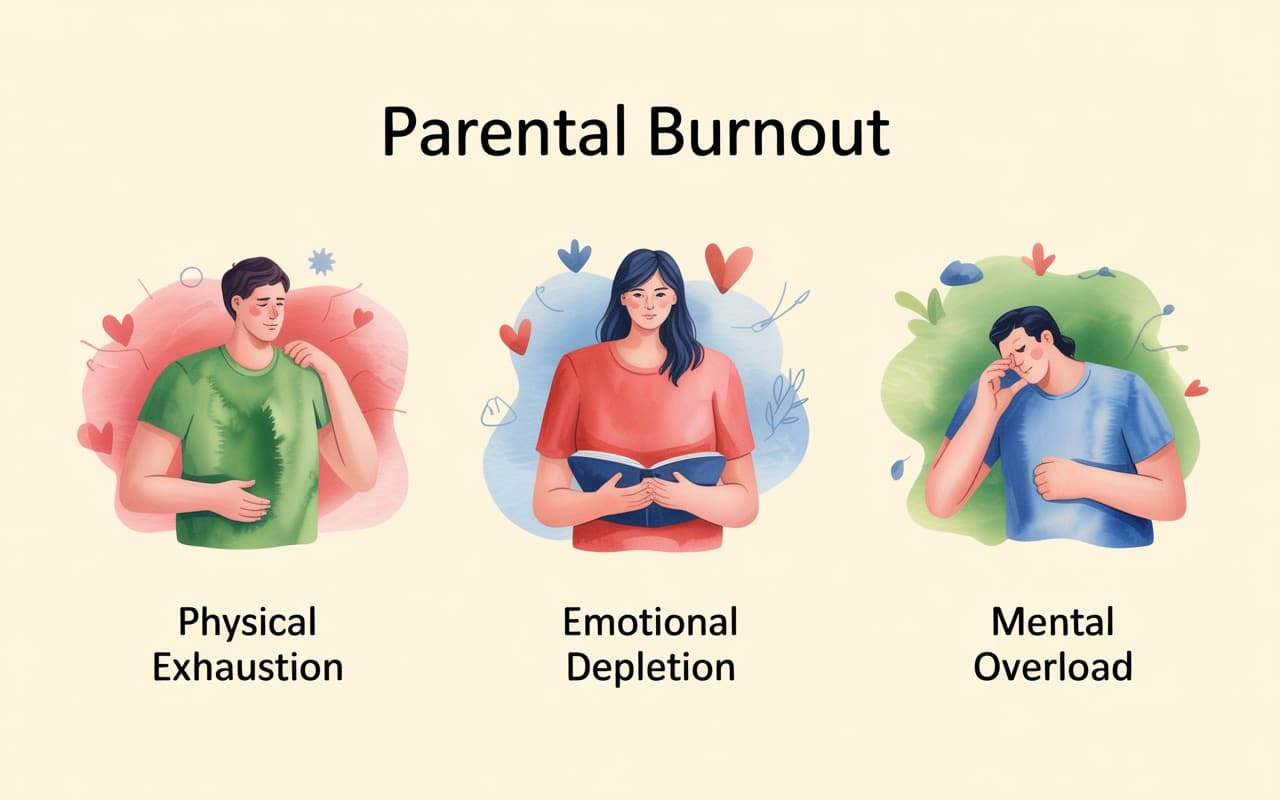
Parenting exhaustion, also called parental burnout, is the state of deep physical, emotional, and mental depletion that comes from the chronic stress of raising children without adequate recovery. It goes beyond ordinary tiredness. It’s the kind of tired that sleep doesn’t fully fix, the kind where you feel emotionally distant from your kids even when you’re standing right next to them, the kind that makes the simplest parenting task feel impossibly heavy.
Researchers define parental burnout as a syndrome characterized by overwhelming exhaustion, emotional distancing from one’s children, and a loss of confidence in one’s ability to parent effectively. It is distinct from general depression or anxiety, though the two can overlap. It can affect any parent: new parents, experienced parents, stay-at-home parents, working parents, single parents, and parents of children with higher support needs.
Is It Normal to Feel Burned Out as a Parent?
Completely. Parenting exhaustion is not a sign of weakness or proof that you love your children any less.
A separate OSU survey found that 62% of parents felt burned out by their responsibilities, and nearly 4 in 10 felt they had no one to support them in their parenting role.
In August 2024, the U.S. Surgeon General issued a formal public health advisory, Parents Under Pressure, about the mental health crisis among parents. The advisory found that 48% of parents say most days their stress is completely overwhelming, compared with 26% of other adults. These numbers don’t describe a small group of parents doing it wrong. They describe a widespread pressure point.
Your exhaustion is not evidence of failure. It is evidence of a gap between what you’re giving and what you’re being given back.
What Are the Signs of Parenting Exhaustion?
Parenting exhaustion can look different for every parent, which is part of why it’s so easy to dismiss or minimize. Here are the most common signs to watch for:
- Sleep that doesn’t restore you. You wake up tired even after a full night’s sleep. The fatigue feels deeper than physical.
- Emotional distance from your kids. You’re physically present but mentally checked out, going through the motions without much connection.
- Survival mode thinking. Your entire focus narrows to just getting through each day with the bare minimum done.
- Irritability and a short fuse. You’re snapping at your children over small things and feeling immediate guilt afterward.
- Loss of joy in parenting. Things that used to feel rewarding now just feel like tasks on an endless list.
- Dread of the day ahead. You wake up already overwhelmed by what is coming.
- Increasing isolation. You pull away from friends, your partner, or other parents because you have nothing left to give socially.
- Changes in basic self-care. You skip meals, shower less, or stay up far too late just to get a few minutes alone.
- Questioning yourself as a parent. You feel like you’re not the parent you wanted to be, or that your kids deserve better.
If you’re reading this list and nodding at several of them, you are not alone. These are not character flaws. They are symptoms of a system that has been under too much strain for too long.
What Causes Parenting Exhaustion?
Parental exhaustion rarely has a single cause. It accumulates from a cluster of pressures that are often invisible to the outside world.
The Mental Load No One Sees
One of the biggest and least-discussed drivers of parental burnout is the mental load: the invisible cognitive labor of running a household and a family. This includes planning meals, tracking school schedules, managing appointments, anticipating your child’s needs, managing behavior, and making hundreds of micro-decisions every single day. Research shows that in households with children, mothers carry approximately 71% of this mental load, often on top of full-time employment.
Doing More Than Any Previous Generation
Today’s parents are working harder than ever in every direction at once. According to the U.S. Surgeon General’s 2024 advisory, time spent on child care has increased 40% for mothers and 154% for fathers since 1985, while work hours have also increased. Parents are spending more time parenting and more time working, while spending less time resting, connecting with partners, and caring for themselves. The math simply doesn’t work.
Perfectionism and Social Comparison
Social media has created a culture where everyone else’s parenting looks effortless, joyful, and beautifully coordinated. The OSU research identified perfectionism as one of the strongest predictors of parental burnout, specifically the pressure to meet unrealistic internal and external expectations about what a “good parent” looks like. When you’re already running on empty, measuring yourself against an impossible standard is devastating.
Lack of Support and Community
Modern parenting is remarkably isolated. At no other point in human history have one or two adults been expected to meet all the physical, emotional, social, and spiritual needs of children entirely on their own. The village that once surrounded families has largely disappeared, and the research on parental burnout consistently confirms that lack of social support is a major risk factor.
How Do I Stop Being So Exhausted as a Parent?
Recovery from parenting exhaustion isn’t a single action. It’s a direction. Small, consistent shifts in how you think about yourself and what you allow yourself to need can make a genuine difference over time.
Stop treating exhaustion as a moral failing
The first and most important step is permission: permission to be tired, to be struggling, and to need help. You can love your child deeply and be completely worn out by the work of raising them. Both are true at the same time.
Name the type of exhaustion you're experiencing
Physical exhaustion calls for rest and physical care. Emotional exhaustion requires connection, expression, and being heard. Mental load exhaustion often requires restructuring: delegating, letting some things go, and having honest conversations about what needs to change.
Protect micro-breaks like they're non-negotiable
Short time-outs throughout the day can help prevent depletion from compounding. Closing a door and breathing quietly for five minutes, sitting in your car before going inside, or listening to music while cooking all count. The goal is not going hours and hours without any moment that belongs to you.
Ask for help out loud
Whether it’s telling a partner what you specifically need, leaning on grandparents, hiring a sitter for a few hours, or texting a friend “I’m having a really hard time,” reaching out breaks the isolation that feeds burnout. People often want to help. They usually just need to know how.
Grieve the gap between expectation and reality
Many exhausted parents are quietly grieving the distance between the parent they imagined they’d be and the one they feel like they are. That grief is real. You can fall short of your own expectations and still be exactly the parent your child needs.
A kinder sentence can be the first small foothold.
Daily Parent is a free iOS app built for parents who are hard on themselves. It offers affirmations designed for real parenting moments: the guilt, the comparison, and the feeling that you're not enough. Sometimes the most powerful thing is a gentle reminder that you're doing better than you think.
Download on theApp Store
Can Parenting Exhaustion Affect My Child?
This is often the question parents are most afraid to ask. The answer is yes: unaddressed parental burnout can affect children, which is precisely why taking care of yourself is not selfish. It’s parenting.
Research consistently shows a strong link between parental mental health and children’s emotional and behavioral outcomes. When parents are burned out, children are more likely to experience emotional and behavioral difficulties, and harsh parenting practices increase significantly. A parent’s regulated nervous system is one of the most powerful tools for a child’s emotional development.
The oxygen mask analogy is not a cliché. It is exactly right. A parent who is running on empty cannot give their child what a parent running on something can give. Recovering from exhaustion is one of the most genuinely child-centered things you can do.
What Is the Difference Between Parenting Exhaustion and Depression?
Parental burnout and depression can overlap, and both deserve attention, but they’re distinct. Burnout tends to be specifically connected to the parenting role: you may feel exhausted and detached when dealing with your children while still feeling like yourself in other areas of your life. Depression typically affects mood and functioning across all domains, including work, relationships, and sense of self.
How Do I Recover and Get More Energy as a Parent?
Recovery is not linear, and it rarely looks dramatic. It looks like sleeping when you can. Saying no to one optional commitment. Telling someone the truth about how you’re doing. Letting the dishes sit and lying down for 20 minutes. It looks like changing the voice in your head from “I’m failing” to “I’m exhausted and I’m still here.”
If burnout is severe, working with a therapist can make a meaningful difference. Research from the Journal of Pediatric Health Care has found that intervention programs targeting parental burnout can reduce symptoms while also reducing harsh parenting practices. Cognitive behavioral skills, support groups for parents, and brief mindfulness practices can all help. You don’t have to figure this out alone.
While the larger structural issues that create parental burnout require systemic change, there are genuine things you can do right now to start recovering your energy. Sleep comes first, whenever possible. Movement helps more than most parents expect; even a 10-minute walk can shift your emotional state. Social connection is protective. And the quality of your internal self-talk matters enormously.
Parents who practice self-compassion, responding to their own struggles with the same kindness they’d offer a friend, consistently report lower levels of burnout and greater resilience. Caring for yourself is not in competition with caring for your child. It is the same thing.

Frequently Asked Questions
What are the signs of parenting exhaustion?
The most common signs include persistent fatigue that sleep doesn't fix, emotional distance from your children, irritability and a short fuse, dreading the day ahead, loss of enjoyment in parenting, and a sense that you're just going through the motions. Physical symptoms like frequent illness, headaches, and disrupted sleep are also common. If several of these sound familiar, you may be experiencing parental burnout rather than ordinary tiredness.
Is it normal to feel burned out as a parent?
Yes. It is far more common than most parents realize. A 2023 Ohio State University study found that 57% of parents self-reported burnout. The U.S. Surgeon General issued a formal 2024 public health advisory on parental stress, citing that nearly half of parents feel completely overwhelmed most days. Feeling burned out does not make you a bad parent; it makes you a human being under enormous pressure.
What causes parental exhaustion?
Parenting exhaustion typically results from a combination of factors: the invisible mental load of managing family logistics, doing more than previous generations while receiving less structural support, social isolation, perfectionism and comparison pressure, financial stress, and the chronic physical demands of caring for children. No single cause is usually responsible; it tends to accumulate over time.
How do I recover from parental burnout?
Recovery begins with permission: permission to be tired and to need help. Practical steps include protecting small daily breaks, asking specifically for support from a partner or community, addressing the mental load distribution in your household, and practicing self-compassion rather than self-criticism. For severe burnout, working with a therapist has been shown to meaningfully reduce symptoms.
Can parenting exhaustion affect my child?
Research confirms that unaddressed parental burnout can impact children's emotional and behavioral development. Burned-out parents are more likely to engage in harsh parenting and emotional withdrawal, both of which affect children. This is precisely why recovering from exhaustion is an act of parenting, not an act of selfishness.
What is the difference between parenting exhaustion and depression?
Parental burnout tends to be specifically tied to the parenting role. You may feel depleted around your children while feeling more like yourself in other contexts. Depression typically affects mood and functioning across all areas of life, not just parenting. Both deserve support. If your low mood extends well beyond parenting moments, or if you're experiencing hopelessness, please speak with a doctor or mental health professional.
How can I get more energy as a parent?
Prioritizing sleep is the single highest-leverage action for most exhausted parents. Beyond that, even short daily movement, genuine social connection, reducing the mental load by delegating or letting things go, and replacing self-critical internal dialogue with self-compassion all build real energy over time. There is no shortcut, but small consistent actions do accumulate into recovery.
What should I do if I feel like I have nothing left to give?
Start by telling someone: a partner, a trusted friend, or a doctor. You don't have to have it figured out. Saying "I'm not okay right now" is a complete sentence and a place to begin. If you have no support network, look into employee assistance programs, community parenting groups, or telehealth therapy options. You are not supposed to manage this alone.